by Abi Hynes
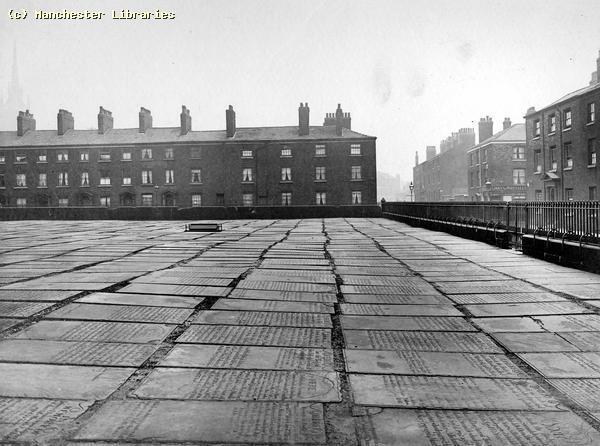
Location: site of St. John’s Church, now St. John’s Gardens, Byrom Street
What are they going to do with the bodies?
It’s the question that remains tactfully unanswered, and I think of the sermon I would have given a year ago: Christ driving the traders from the temple. They say they’ll put up a stone; one stone, presumably, in a ‘catch all’ gesture, something with steps for visitors to eat their sandwiches on. But I’m preoccupied with the physical practicalities of the thing. Will they dig them up and move them? I imagine it – this gruesome exodus of dead flesh – and it seems unlikely. What of the smell?
We’re allowed to come here, those of us who still recognise the names on these dismal flat tombstones. They lie side by side, a pavement of swelling stone and marble, flat and low, like the people under them, I supose. I haven’t been here since I was a boy. Seeing them, I understand why other churches build those towering cherubs; fat stone fingers stretching heavenward, plump faces and rounded buttocks belying the wasting beneath. We build them like we build all our monuments; so that something may stand tall for us when we must lie down and sleep.
These un-lofty memorials are laid so tightly together that there’s nowhere to walk but over them. I imagine the dead knocking, their knuckles turning to dust as they rap up in reply to our trespassing footsteps. Some of the slabs are slightly loose, and I place my feet carefully in the centre of each one as I pick my way across this bizarre evening playground, avoiding the cracks.
We’re quickly losing the light; some people have brought torches to help them pick out the names of brothers and husbands and great-great-aunts. The beams of the torches swing eerily about. It’s making me feel dizzy, like watching other people on a fairground ride. I want to find him – it – quickly, and go home.
A younger man approaches me and shakes my hand without an introduction. His face is familiar, or perhaps it only ought to be. I’m pleased with his unidentified company; it offers me the opportunity to make my quip about being on the graveyard shift. A little awkward, when I realise we don’t know each other. I was just standing on his grandmother.
Twenty-two thousand, they say are buried here. That number seems impossible in this little plot of earth – hell, half that number seems impossible. They must have stacked them like bunk beds. I’d always thought of him alone down there, not packed in like prisoners, three or four deep. It’s true; I feel him strongly here. I feel as if I’m nine years old and he’s about to tap me on the shoulder. We shouldn’t scoff at people’s superstitions. I swear, beneath my feet, I can hear a child laughing. Ridiculous.
It’s true what they say, you see, about churches gradually sinking into the ground. But it isn’t really that the ground is swallowing them; it’s the consecrated earth around them rising up, with the sheer physical mass of human remains that we shovel into it.
I find him – flat, unimpressive thing – and yet the solidity of him lying there startles me. He reaches out of the earth, and he’s the child, not me, and when he takes my hand it’s small and soft in mine. I ought to be surprised, perhaps. But we are all little when we die. I’ve held the hands at that moment, and felt the bones shrink. ‘Getting ready for my coffin, Vicar,’ they say, stooping.
It’s difficult to be spiritual, surrounded by such obvious physical evidence of our mortality. Thy kingdom come, we say. We all rot. All of us; our thoughts and our promises and, yes, our passions too – everything we might call the soul – it all rots. Don’t shake your head; look down, look underneath your feet. You are standing over centuries of prayer.
The dead keep knocking. Selfish, clamouring voices, the old ones jealous of the freshly dug graves, the ones with still-damp rot, the ones with flowers bought on Sundays.
The dead keep knocking. Even the ones four layers down, the ones that have been dust for centuries, the ones with no living relatives to send their messages to. Psst – pass it on – like a great vertical game of Chinese Whispers – Pass it on – tell them – don’t forget me.
Abi Hynes is a drama, fiction and poetry writer based in Manchester. She is also Co-Artistic Director of theatre and film company Faro Productions, and runs First Draft, a bi-monthly cabaret night showcasing new writing and performance at the Castle Hotel. Follow @AbiFaro, @FaroProductions & @FirstDraftMcr on Twitter.
This story was commissioned for Manchester Histories Festival in 2014 as part of Ruined: Short short stories about long lost places, which took place at Blackwell’s Books.
by David Hartley
Location: The Cenotaph, St. Peter’s Square
We huddle on the platform of St. Peter’s Square, working through our memory games, holding on. Around us, the once great city of Metrolink howls against winter but it’s a battle long lost. The city lies abandoned, forgotten, succumbed to the plague. We three are the last and we are struggling. I slip my fingers from their places in my gloves and fold them into cracking fists. Then Lance asks a question and any last warmth we might’ve had flees for the Pennines.
‘Why we here?’
He is the youngest and hence the most fragile. Percy tuts.
‘Waiting for Arthur,’ I say and the frown clears from Lance’s wrinkles, replaced in an instant by a flicker of fear.
Percy passes him the Thermos. ‘Keep it together gents,’ he says.
We try.
*
The Town Hall bell echoes out the hour like it’s trying to coax its citizens back, but each peal is lost to the whips of the wind and Metrolink’s empty buildings flatly ignore it. But then a new sound cuts in and we, at least, are stirred: it is familiar, it is remembered, even by Lance. A crackle, a shriek, like a distant banshee. Giddy, we lean out of the shelter and peer up the lines.
The squashed block face of an angry wasp descends from the Deansgate Castlefield hill. It heralds its own arrival with a soft toot.
‘That Arthur?’
Percy laughs. ‘Can only be.’
He always knew how to make an entrance.
Except it isn’t: not quite. As the tram slows and pulls to a perfect stop, we see a different face at the driver’s seat. It’s Gwen, togged up like Queen Liz, eyes glistening against the early morning, hunched over the controls but smiling.
She hits the button for the doors and beckons us inside.
*
‘It took him three sleepless nights but he got it.’
‘All of it?’
‘Where it is, how to get it and where it goes. I told him, I said; it wasn’t going to do his heart any good, I said; you’ll tire yourself out but, well, here we are.’
Here we are, three men gearing up for a quest, one woman to guide us, tram seats stocked with equipment, and one sleeping passenger. Arthur, our memory king; lying across two seats and barely breathing. His gummy eyes open and close, pearls inside decaying clams.
‘We can’t come with you,’ says Gwen, her husband’s tiny hand between hers. ‘He wanted to but we can’t.’ Arthur starts to mumble, something about a holy cross, but Gwen soon shushes him. ‘Help me carry him out chaps,’ she says, and we do.
We lay him on the seats of the platform and ice seems to grasp him as soon as our hands lift away.
For a moment, none of us move. We watch the fading clouds of Arthur’s breath, listen to the hum of the waiting tram.
‘Where do we bring it?’ I ask, eventually.
Gwen doesn’t answer.
‘Here,’ says Percy, frowning. ‘We bring it here.’
Gwen smiles a confirmation, waves us away.
*
Percy’s at the controls.
He glides us onto the Albert Line, up beneath the shell of Victoria station, then into a long curve along the Irwell, through the glittery vacuum of Spinningfields and past the old Opera House. The tram wants to stop at the Beetham but Percy overrides and pushes it on and we emerge on a slow stretch up Deansgate.
Throughout the whole journey Lance has clasped his head in his hands, blocking out sound and vision, nodding through some memory game. Alphabet football teams or stations of the Eccles line. Whatever it is he needs full concentration. A dangerous tactic. What if you don’t recognise the world when you come back up?
I count through our inventory. Three pickaxes, three sledgehammers, lots of rope, four heavy sheets of tarpaulin, three slices of Victoria sponge in three Tupperware tubs. Gwen’s own recipe, plenty of jam.
The tram lurches to the right and points us at the yellowed facade of Metrolink Town Hall. Prince Albert himself stands in the way so the track obliges and bends around to the left. Behind me, Lance whimpers.
‘What are we doing?’
Every bit of me drops. That’s it. He’s gone.
I sit down next to him and put my arms around his shoulders. ‘We’re getting the sacred stone Lance, remember? For Arthur?’
The collapsed-in features, the resistant brow, the deep quiver of worry. Long gone. He shakes his head. ‘We’ve forgotten something,’ he says.
‘We?’
‘Something bad.’
‘What, Lance? What we forgotten?’
‘I don’t know. I’m sorry. Something bad, something we all did. I don’t know.’
I grab a Tupperware, pop the lid and dig out the wedge of cake within. We all go like this, eventually. There’s no point him fighting it anymore. ‘Come on now my old mate, have a bit of this.’ He nibbles at it, dots of jam and cream speckle across his chapping lips.
‘You help me and Percy, alright? We’ve got to get us the stone and take it back to Arthur; that’s all.’
The doors of the Metrolink Town Hall blink red then green then swish open. Percy slows us down. As we cross the threshold, he shouts back.
‘You start Lance.’
‘It’s just you and me now Perce.’
He swears and kicks something. ‘Fine, whatever. I’ll start. Altrincham Line: Piccadilly.’
The darkness closes in as the doors swish shut.
‘Piccadilly Gardens,’ I say
*
‘St Peter’s Square.’
Inside is a deep cavern of metal lines. Our tram is grabbed and clicked into automatic, as if we are cargo in some galactic factory. Percy tears himself from the cabin and smacks me across the shoulder.
‘Er, Deansgate Castlefield.’
Above, thin wires squeal, screech, spit while tracks held high from the abyss pull us along a fragile rollercoaster; a turn, a rise, a fall, but forever locked at the edge of the place, pulled into a wide, lazy circle. Beyond, other wasps awaken and start to move. Sentries, pursuers, demons protecting some darkly held secret.
‘Cornbrook!’ shouts Percy, and he has to shout because the squeals have risen to screams.
‘Trafford Bar.’
There is something; some other thing, right in the centre, but I cannot draw my eyes from the lines and the lights and the hunting carriages, so I only catch glimpses, forgotten as soon as seen. Something tall, something strong. What was it?
‘Old Trafford.’
Lance starts to scream and Percy grabs his mouth and muffles him: what if there is a beast in here that shouldn’t be awakened? What is this network guarding?
‘Stretford!’
‘Dane Road.’
‘Brooklands.’
‘No!’ I shout, tear my eyes from the place to look at the transfixed Percy. Sale not Brooklands. He’s forgotten Sale. He blinks. He blinks. He blinks, then looks at me.
‘What?’ he says.
I lock close my eyes and fumble for the cabin. I don’t know the controls, wouldn’t remember them if I ever did, but I grab a thing that feels like acceleration and push it. Both of my friends fall utterly silent and so do I. After a too long a time, so does the tram.
*
I prise open the doors and clamber out.
I’m at the centre. There’s something here. A single, tall structure, engraved, embossed, quiet, reverent. I touch it.
Stone.
I think hard.
Old Arthur likes stone. He’s always on about it. I could take him some back.
I heave one of the sledgehammers and use all my strength to strike the thing to bits. It is soft. It doesn’t take much.
I use a pickaxe to make the big pieces smaller then fill up the aisles of the tram.
Hours later I’m off again. Back and back and back.
To where? To St. Arthur’s Square to see a man called Peter.
*
I don’t remember this place. Some kind of city. There’s no-one around, so maybe it’s early morning. Some of the sounds are familiar, some of the smells. There was something bad here. Or maybe not here specifically, but everywhere, somehow. Something we all did. It weighs down on me; a sadness, a guilt, a shame. An anger.
I don’t like the city much; it’s all too yellow.
Someone has left a laminate map which guides me through the streets to where I need to be. St Peter’s Square, not St… what was the other one?
When I arrive there’s two people waiting on the platform. A woman and a man. The man is lying down; the woman is sitting with him. She raises an arm, crooks her finger.
What an inconvenience, I think.
I get off and stride over. She turns her wrist, straightens her finger and points at the track in front of my tram.
‘There,’ she whispers. ‘Stone.’
Her eyes close, her hand drops, her head droops. What is it she wants?
I go back into the tram. It’s full of old bits of broken stone and two blokes, fast asleep in each other’s arms.
Strange.
I take a lump of stone and throw it outside. It skitters and falls onto the tracks.
It seems, somehow, to fit.
I take another piece and throw it down next to the first. The old woman opens her eyes at the sound, lifts her head. I take a bigger chunk and roll it off the edge.
It all needs to go here, I’m thinking. All the stone.
I take it slow and it takes me a while, but eventually a small cairn has appeared. The woman nods, smiles, then gets up from her seat and starts to help. Very soon there are two piles.
The men in the tram wake up. They watch us for a while then decide to join in. Must seem like fun. Like the right thing to do.
This stone, I think, is important somehow. Gwen carries it with such grace and care.
Gwen: that’s her name. I knew I knew her from somewhere.
Lance and Percy share a laugh over something. It’s nice to see Lance smiling again; he’s been so upset recently.
It takes us all day and our hands go numb, but we do it. Every last crumbling fragment of that beautiful stone lies heaped between the tracks.
‘Thank you, Gareth,’ says Gwen, with a quick peck on the cheek. ‘But there is one last piece.’
I’d almost forgotten the man asleep on the plastic seats behind us. As we take hold of him he seems to twitch awake, but he doesn’t resist.
‘Lay him on top,’ says Gwen, and we do.
Arthur opens his eyes. That’s his name; Arthur.
‘Hello chaps,’ he says, his eyes like a misted lake clearing with the sunrise. ‘I’m glad you’re all here. Gather round, gather round.’
We step into a circle around him, Gwen at the head, stroking his hair.
‘There’s something I need to tell you about.’ He pauses. Frowns. Waits.
It is a weighted moment; the fresh joy of waking suddenly sunk into the heaviness of remembered life. I realise I’m cold again. Bitterly. We all wait patiently as the silence rolls on for a minute or two. I’m not really sure what to think. Then, with a pop and fuzz, I start to remember things. Strange things. Distant things. Bad things. Things we did that we can never change.
‘There was this war,’ says Arthur, ‘And everyone played their part…’
David Hartley is a short story writer who lives between the raindrops in Manchester and never gets wet. You can read his weekly blogposts on davidhartleywriter.blogspot.
This story was commissioned for Manchester Histories Festival in 2014 as part of Ruined: Short short stories about long lost places, which took place at Blackwell’s Books.
By Susie Wild
Location: Wilmslow Road
The warning signs are there. Jo’s voice is rising in pitch. There is going to be a row. Or tears. Possibly both. We are all hungover, off to see our mate’s mate’s band play for the second night in a row at the same venue.
Fuel; we sure need some.
Manchester is losing its grimy shine, the but-we-aren’t-in-Wales gleam of adventuring appeal. Drastic action is needed. Trailing behind the whiners and need-to-be-drunk-again ditherers I catch Kate’s eye. She knows the drill, the nod is almost imperceptible. She grabs my wrist and we take a sharp right down an alley, careering, our limbs windmilling into the first bar we come across.
In the dimly lit pub we lean summer-sticky arms on the syrup-sticky bar, order two house triples and down them. Apart from the barmaid we are the only women there. Around us the smell of Brylcreem and urinals permeates the air; rows of quiffs compete with each other for vertical space. An overweight Teddy Boy is singing one karaoke song after another, in tune but lacklustre, his beer gut heaving up and down in time to the music, wiggling his skinny tie like a worm. The room ignores him.
We march up to the cuddly teddy and grab the songbook. Choose ‘Big Spender’. Belt it out. Loudly. Tunelessly. Giggling like the schoolgirls we are. The room ignores us. We love that. We order another triple each, down it, and then leave the surreal Lynchian pub. Run back out into the night, eyes wild, shrieking. Finding the others smoking in the queue outside the gig venue. Jo’s eyeliner streaks her cheeks, but she is exhaling laughter with her nicotine. A storm has passed.
Susie Wild is one of Parthian’s Bright Young Things. Her debut collection of short stories, The Art of Contraception, is out now. www.brightyoungthings.info
By Sarah-Clare Conlon
Location: Oldham Street
She looked at the sheet of paper again. The first time, she’d merely glanced; now she stared, scared. ‘Missing,’ it said, along with a description of the lost item and a number to call and report any details regarding its whereabouts. There was no picture, just words, in heavy black type. Arial. The ‘Missing’ was bigger than the rest, to make you look, make you stare. She was staring.
The flyers had appeared overnight, suddenly fluttering their whiteness in the breeze of dawn, as abrupt as mayflies or snowdrops, changing the landscape in a fingerclick so she awoke to a whole new place. They were everywhere: sticky-taped to bus stops, cable-tied to posts and poles, drawing-pinned to trees, Blu-Tacked to the insides of early opening newsagents’ windows, scrunched-up in bicycle baskets. Some were clamped under the windscreen wipers of those cars that had not yet been moved, others shoved into the clasp of letterboxes. The one she was studying was glued to a graffitied rollershutter.
She retrieved her phone from a back pocket and jabbed at the Contacts icon. She tapped on the screen, waited a couple of seconds then entered the digits into the memory, saving them as ‘Missing’. The notice had stirred something deep within her, jogged a memory, rung a bell. She felt she had seen the thing that was gone and perhaps if she looked carefully enough, she would see it again. She vowed to keep an eye out, keep an eye on the pavements as she wandered. Perhaps she would find it lolling in a dirty doorhole or imprisoned in one of those weird whirlpools of sticky leaf clumps and chip papers and cat hair and discarded ideas and broken promises.
She took one last glimpse at the sign before running away, back up the street the way she’d come.
‘Missing. Reward offered. Please call 07276 059439 with any information. Last seen in or around the Northern Quarter on Wednesday night. Missing: my sanity.’
Sarah-Clare Conlon is an editor, writer and press officer based in Chorlton. When not telling tales of death and destruction, she can be heard swearing on bikes and boats. http://wordsandfixtures.blogspot.com/
By Gill James
Location: St Peter’s Square
Christina de Vries checked her watch. Nine thirty. With luck, she would be home by ten. The students’ showcase had gone well. She was pleased, but she’d be happier still when she got home. This was Manchester and it was a Friday night. She hoped the tram would come soon. She was a bit anxious about the short walk from the station in Radcliffe as well: she’d not been able to get on the car park earlier.
The tram must be due soon. There was quite a crowd on the platform. Every twelve minutes they were supposed to be.
One of the youths who were waiting at the far end of the station started singing Chris de Burgh’s Lady in Red. He’s got a good voice, thought Christina. He was actually singing it better than Chris de Burgh did, she reckoned.
Except he wasn’t quite singing the right words.
‘Lady in grey,’ he crooned. ‘You’ve never looked as old as you do tonight, I’ve never seen your hair so almost white, I’ve never seen so many men look so askance, running if they’d get half a chance…’
Cheeky bugger, thought Christina.
Well, she wasn’t having this. Even if she had got a very significant birthday coming up soon. Loads of people had asked her if she had highlights put in her hair. She was very happy with how the grey was just in the right places and looked almost blond. She was still very brunette in places. But she was wearing a grey coat and scarf. She supposed he had a point.
She looked at the other people standing on the platform. They averted their eyes, embarrassed, apathetic.
I’m not having this, thought Christina.
What to do, thought, what to do? Should she phone the Police? No, that was probably over the top. Should she confront him? No, that would probably make it worse and be even more embarrassing. She looked at the young woman standing next to her on the platform. The woman looked down at the ground and half-turned away from her.
Right, thought Christina. I’m going to do this thing.
He had a really nice voice. Baritone she thought. So, he was singing a bit lower than a tenor. Pity, she was a tenor. But she couldn’t get down quite that low. Could she find the harmony? She thought she could.
He was on the second run through of the song. ‘I’ve never seen that jacket you’re wearing,’ he sang, ‘or the highlights in its folds that catch your hair. I have been blind.’
She had the harmony in her head. Now all she had to do was sing it. She took a deep breath.